
What Is a Steel Rolling Mill? Working Principle, Types & Industrial Uses
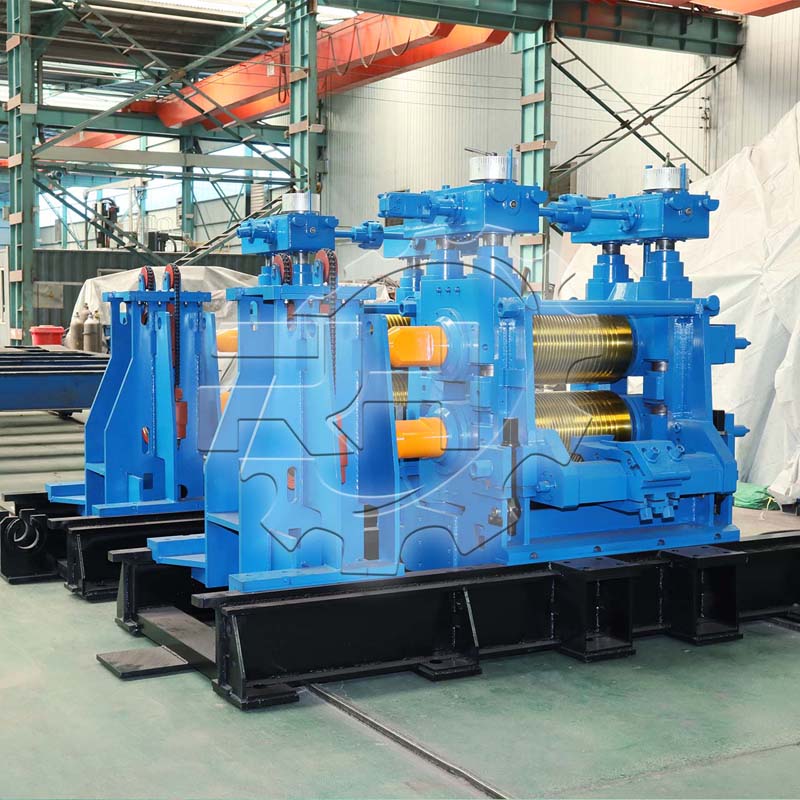
Heavy-duty 2-high rolling mill stands manufactured for steel rebar and wire rod production lines
Introduction
A steel rolling mill is fundamental metallurgical machinery designed to reshape steel billets, slabs and ingots via plastic deformation. Rotating metal rolls apply compressive force to reduce material thickness, extend length, and form semi-finished or finished steel profiles.
As one of the most critical production equipment in the metalworking industry, steel rolling mills produce nearly all mainstream steel products for construction, infrastructure, machinery manufacturing and transportation. Compared with forging or casting, rolling delivers higher output, stable dimensional accuracy and improved internal metal grain structure, making it the preferred mass-production forming method for steel.
How Does a Steel Rolling Mill Work?
The core mechanism of steel rolling relies on metal plastic deformation:
1. Raw steel billets are heated above recrystallization temperature for hot rolling, or processed at room temperature for cold rolling.
2. The steel workpiece passes through the precise gap between rotating work rolls.
3. Roll pressure squeezes the steel, thinning its cross-section while elongating the material.
4. Multiple rolling mill stands work sequentially to gradually achieve the target size, surface quality and mechanical performance.
Modern continuous rolling production lines connect dozens of rolling stands together to realize uninterrupted, high-speed automatic production.
Advantages of Modern Industrial Steel Rolling Mills
✅ High continuous production efficiency for mass manufacturing
✅ Optimizes steel internal grain structure to enhance mechanical properties
✅ Consistent dimensional precision for finished steel profiles
✅ Modular structure for convenient installation and maintenance
✅ Support automated operation to reduce labor expenditure
✅ Custom roll grooves available to produce multiple steel profiles
Conclusion
Steel rolling mills occupy an irreplaceable position in the global metallurgical industry. Rolling technology converts crude steel billets into usable industrial and construction steel materials. Whether you operate a large integrated steel factory or a small steel processing workshop, selecting high-quality, durable rolling mill equipment directly determines your production capacity and finished product quality.
If you are looking for customized steel rolling mill solutions, continuous rolling line layout design or rolling mill spare parts, consult professional metallurgical machinery manufacturers for personalized technical proposals.
Frequently Asked Questions (FAQ — Boost Google SEO Ranking)
Q1: What raw materials can a steel rolling mill process?
A: Carbon steel, low alloy steel and stainless steel billets are common processing materials.
Q2: Can a steel rolling mill produce construction rebar?
A: Yes. Continuous hot rolling mill lines are standard equipment for producing HRB400, HRB500 deformed steel rebar.
Q3: What is the difference between roughing mill and finishing mill?
A: Roughing mills realize large cross-section reduction; finishing mills conduct precision rolling to achieve final steel sizes.


 +86-15133440248
 +86 15133440248